
WELCOME BONUS 300%
UP TO €2000 + 100
FREE SPINS
UP TO €2000 + 100
FREE SPINS
Home → Roulette
Roulette at Frumzi
D'Alembert and Fibonacci Against the Same Table Limit
The D'Alembert betting system involves increasing the bet by one unit after a loss and decreasing by one unit after a win, aiming to recover losses gradually. At Roulette Amerikanisch, with a house edge of 5.26%, this strategy faces significant challenges. The payout for a Straight bet is 35:1, and for even-money bets like Rot/Schwarz, it is 1:1.
The Fibonacci sequence, where each number is the sum of the two preceding ones, is another progression system often applied to even-money bets. On Roulette Französisch with La Partage, the house edge for even chances is reduced to 1.35% due to the 50% refund on a zero. This makes it a more favourable environment for such strategies compared to the American variant.
However, both systems are constrained by table limits. Frumzi casinos often feature live tables like Blaze Roulette, with bets ranging from 0.20 € to 5,000 EUR. While the 35:1 payout on a Straight bet remains consistent, the high table limit can accommodate larger bet progressions, yet the inherent house edge will eventually impact the player's bankroll over extended play.
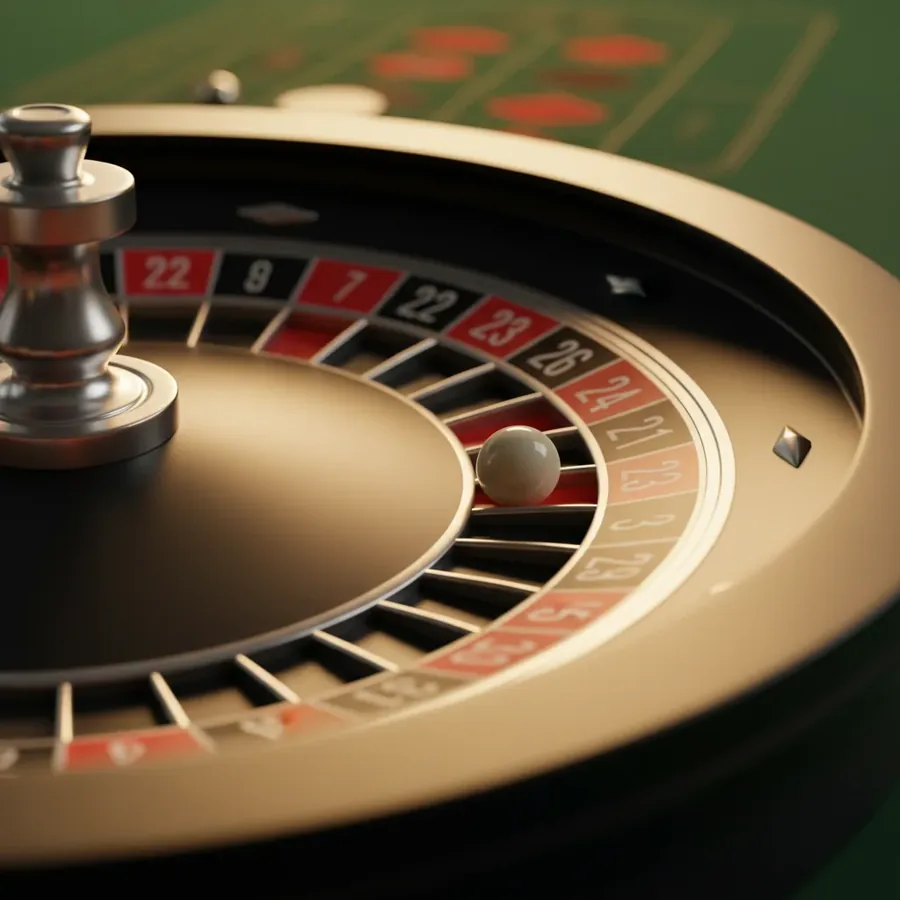
How the Random Generator Maps 37 Pockets
The theoretical framework for a fair game relies on a random number generator (RNG) accurately simulating the outcomes of a wheel with 37 pockets, as found in European Roulette. Each sector, numbered 1 through 36 plus a single zero, has an equal probability of being landed upon. The RTP for this configuration is 97.30%, with a house advantage of 2.70%.
This RNG process ensures that each spin is an independent event. The payouts are structured such that a Straight bet returns 35:1, while even-money bets like Rot/Schwarz pay 1:1. The consistency of these payouts across all 37 sectors, barring the zero, is a fundamental characteristic of the European wheel's design.
For high rollers, understanding that the RNG's integrity is paramount is crucial. Even with advanced betting systems, the long-term outcome is dictated by the house edge. The RNG's operation at Frumzi ensures that the game adheres to the stated RTP of 97.30%, making it a predictable mathematical encounter.
Distribute 500 Euro Bankroll at the Lightning Table
At a Lightning Roulette table, with a bet range from 0.20 € to 5,000 EUR, a 500 Euro bankroll can be strategically deployed across various betting options. The game features 37 sectors on a European wheel, offering an RTP of 97.30%. Payouts for standard bets include 35:1 for a Straight and 1:1 for even chances.
The unique element of Lightning Roulette lies in its multipliers, which can range from 50x to 500x on 1 to 5 randomly selected 'Lightning Numbers' per round. This introduces a variable payout structure that, while potentially lucrative, also affects the overall theoretical RTP. The standard payouts apply to non-multiplied bets.
For a high roller, focusing on bets that include potential Lightning Numbers, such as Straight bets, could maximize exposure to these multipliers. A 500 Euro bankroll could be distributed by placing multiple Straight bets on different numbers or by concentrating on fewer numbers with larger stakes, aiming for a multiplied win, while standard payouts remain fixed.
Session Limit 25 Euro and Fixed Number of Rounds
Implementing a session limit of 25 Euro, combined with a fixed number of rounds, introduces a structured approach to gameplay, particularly relevant for managing exposure at tables like Roulette Amerikanisch. This variant has a 5.26% house advantage due to its 38 sectors, including a double zero (00).
A fixed number of rounds dictates the duration of play. If a player decides to play, for instance, 100 rounds with a 25 Euro session limit, their average bet per round would be 0.25 Euro. This constraint is designed to limit potential losses and prevent extended play, regardless of the betting system employed.
The combination of a low session limit and a set number of rounds significantly impacts high rollers. While the theoretical payouts for Straight bets are 35:1, the restricted bankroll and playing time mean that achieving substantial wins, especially against the higher house edge of American Roulette, becomes statistically less probable within these parameters.
European or American: Which Wheel Pays Better
The European Roulette wheel, with its 37 sectors and single zero, offers a theoretical RTP of 97.30%, resulting in a house edge of 2.70%. All standard bets, including Straight at 35:1 and even chances at 1:1, are calculated based on 36 numbers, ensuring a consistent edge across the board.
In contrast, American Roulette features 38 sectors, including both a single zero and a double zero (00), which increases the house edge to 5.26% while maintaining the same payout ratios for most bets. This means that for every 100 Euros wagered on average, players lose 5.26 Euros at the American wheel, compared to 2.70 Euros at the European wheel.
For high rollers seeking optimal return, the European wheel is demonstrably superior. The lower house edge directly translates to a higher RTP, meaning that over a significant number of wagers, a larger portion of the money wagered is returned to the player. This makes European Roulette at Frumzi casinos the preferred option for maximizing potential longevity and reducing theoretical losses.
Roulette bet types at a glance
| Bet | Payout | Win Chance | Numbers Covered | House Edge |
|---|---|---|---|---|
| Roulette Französisch mit La Partage (gerade Chancen) | Rot/Schwarz 1:1 (bei 0 Rückerstattung 50%), Odd/Even 1:1, Low/High 1:1; Innere Einsätze ohne La Partage: Straight 35:1, Split 17:1, Street 11:1, Corner 8:1 | 98.65% | Bei 0 wird die Hälfte des Einsatzes auf gerade Chancen zurückerstattet (Rot/Schwarz, Pair/Impair, Manque/Passe). En Prison gibt denselben 1,35%. Regel gilt NUR für gleiche Einsätze | 1.35% |
| Roulette Amerikanisch (doppelte Null, 38 Sektoren) | Straight 35:1, Split 17:1, Street 11:1, Corner 8:1, Six Line 5:1, Dozen 2:1, Column 2:1, Rot/Schwarz 1:1 | 94.74% | 38 Sektoren (1–36 + 0 + 00); Auszahlungen wie beim europäischen Rad, aber der zusätzliche Sektor verdoppelt den Hausvorteil | 5.26% |
| Roulette Amerikanisch – Five Number Bet (0, 00, 1, 2, 3) | Five Number 6:1 (deckt 5 von 38 Sektoren) | 92.11% | Einzige Wette am amerikanischen Rad mit Edge über 5,26% – „Fallenwette“. Kein Äquivalent am europäischen Rad | 7.89% |
| Roulette Europäisch (einfache Null, 37 Sektoren) | Straight 35:1, Split 17:1, Street 11:1, Corner 8:1, Six Line 5:1, Dozen 2:1, Column 2:1, Rot/Schwarz 1:1, Odd/Even 1:1, 1-18/19-36 1:1 | 97.30% | 37 Sektoren (1–36 + 0); Auszahlungen wie für 36 Sektoren – daher konstanter Edge auf ALLE Wetten | 2.70% |
| Roulette Französisch, innere Einsätze (La Partage gilt nicht) | Straight 35:1, Split 17:1, Street 11:1, Corner 8:1, Six Line 5:1, Dozen 2:1, Column 2:1 | 97.30% | Rad gleich (37 Sektoren), aber La Partage/En Prison gilt nicht für innere Einsätze – Edge bleibt europäisch | 2.70% |
When Does the Lock for Risk Bets Apply?
In online roulette, risk bets are subject to specific conditions regarding when a lock applies, particularly concerning lower-value wagers. For instance, when playing European Roulette, which features a single zero and 37 sectors, the standard house edge stands at 2.70%. This edge is consistent across all bet types, including straight bets paying 35:1.
This 2.70% house edge on European Roulette is derived from the payout structure, where all bets are calculated as if there were 36 sectors. The inclusion of the single zero pocket means that for every 37 outcomes, the house retains a small advantage. This technical detail is crucial for understanding bet behaviour.
However, specific rules may alter this dynamic. For example, French Roulette with the La Partage rule applied to even-chance bets significantly reduces the house edge to 1.35% when a zero is hit. This exception highlights that not all roulette variants offer the same risk profile for high rollers.
50 Euro Budget at a 1 Euro Table
When operating with a 50 Euro budget at a roulette table where the minimum bet is 1 Euro, the number of potential betting rounds is directly influenced by the game's mechanics. European Roulette, with its 2.70% house edge, offers a theoretical return to player (RTP) of 97.30%. This means for every 100 Euros wagered, approximately 97.30 Euros are returned over the long term.
A 1 Euro bet on a single number (Straight) in European Roulette pays 35:1, resulting in a payout of 36 Euros (1 Euro stake + 35 Euros win). If a player bets 1 Euro on a column bet, which pays 2:1, the payout for a win would be 3 Euros (1 Euro stake + 2 Euros win). These payout structures are standard across many tables.
Therefore, with a 50 Euro budget and 1 Euro bets, a player could theoretically make up to 50 individual bets if no wins occur. However, the house edge of 2.70% ensures that, on average, the player's balance will decrease over time. This is a fundamental aspect of casino mathematics, regardless of the table minimum.
What Doesn't Count as Loss Protection with Zéro?
In certain roulette variants, specific rules are designed to offer a form of loss protection on particular bet types. French Roulette, for example, can feature the 'La Partage' rule, which applies to even-chance bets like red/black or odd/even. If the ball lands on zero, half of the player's stake is returned, effectively halving the house edge to 1.35% for those specific bets.
However, this protection does not extend to all bets or all roulette variants. For instance, in standard European Roulette, which has a 2.70% house edge, there is no such concession when the zero hits. All bets, including inside bets like a 'Corner' bet which pays 8:1, are subject to the full house edge without any refund mechanism.
Similarly, American Roulette, with its double zero and 38 sectors, presents a higher house edge of 5.26%. This variant typically lacks the La Partage rule for any bet type, meaning the zero and double zero pockets always contribute to the casino's advantage without offering any player-facing mitigation on standard bets.
House Edge: What 2.70 Percent Actually Costs
The 2.70% house edge inherent in European Roulette represents the casino's statistical advantage over the player in the long run. This figure is derived from the payout ratios compared to the actual probabilities of outcomes on a 37-sector wheel (numbers 1-36 plus a single zero). For example, a 'Straight' bet paying 35:1 actually has 36 possible outcomes for a win but only 1 winning sector.
To quantify the cost, consider a player consistently betting 100 Euros per hour on European Roulette. Over an extended period, this 2.70% house edge would theoretically result in a loss of 2.70 Euros for every 100 Euros wagered. This might seem small per hour, but it compounds significantly over many gaming sessions for high rollers.
This constant marginal disadvantage means that for every 1,000 Euros wagered by a high roller on European Roulette, the casino expects to retain approximately 27 Euros. While individual sessions can vary wildly due to variance, the house edge is the mathematical certainty that ensures profitability for the casino over millions of spins across all players.
Calculate Payout: Corner 8:1 Plus Bet
When placing a 'Corner' bet in European Roulette, which covers four numbers, the payout is typically set at 8:1. This means for every 1 Euro wagered, a successful outcome yields 8 Euros in winnings, plus the return of the original 1 Euro stake, totalling 9 Euros. The game features 37 sectors, including a single zero.
To illustrate the calculation with a higher stake, imagine a high roller betting 100 Euros on a corner bet. If this bet wins, the payout would be 100 Euros multiplied by 8, resulting in 800 Euros in winnings. The player would then receive their initial 100 Euro stake back, for a total return of 900 Euros from that single winning bet.
The house edge for this 'Corner' bet on European Roulette remains 2.70%, consistent with all other bets on that wheel. This is calculated based on the probability of one of the four numbers hitting versus the 37 total sectors available. The payout structure is designed to maintain this statistical advantage for the casino.
How Long a Session May Last
A session's duration is influenced by the chosen game's RTP, with French Roulette with La Partage offering a superior 98.65% RTP. This high return-to-player rate means, theoretically, less of the player's stake is retained by the house over extended play. For high rollers, maximizing time at the table with favourable odds is paramount for sustained engagement.
The house edge also plays a critical role in session longevity. European Roulette, with a 2.70% house edge, is less demanding on a player's bankroll compared to American Roulette's 5.26% edge. This 2.56% difference can significantly extend playtime for high rollers, especially when considering the impact of repeated bets.
For those engaging with live dealer options like Blaze Roulette, the betting limits of €0.20 to €5,000 per spin are a key consideration. This broad range allows high rollers to participate actively without immediate pressure on their capital, provided they manage their stakes judiciously across the 37 sectors of the European wheel.
French with La Partage vs European
French Roulette with La Partage presents a distinct advantage for high rollers focused on even-chance bets, boasting a theoretical RTP of 98.65%. This is achieved by refunding half the stake when the ball lands on zero on outside bets. This rule significantly reduces the house edge on these specific wagers to a mere 1.35%.
European Roulette, while a strong contender, operates with a fixed RTP of 97.30% and a consistent house edge of 2.70% across all bet types. This means that while the payout for a Straight bet remains a high 35:1, the house retains a larger percentage of all wagers over time compared to the La Partage variant.
The practical implication for high rollers is clear: for strategies heavily reliant on even chances like Red/Black or Odd/Even, French Roulette with La Partage offers superior player retention over a prolonged session. This is directly attributable to the 1.35% house edge versus the 2.70% on European Roulette for those specific bet categories.
Wheel Speed and Ball Toss in Real Wheel
In live dealer roulette, the physical dynamics of the wheel and ball are crucial for the perceived fairness and pace of the game. Authentic Gaming's Blaze Roulette, for instance, uses a European wheel with 37 sectors, offering a standard 35:1 payout on straight bets. The speed of the wheel and the ball's trajectory directly impact the spin duration.
The live host's role in Blaze Roulette, operating from 19:00 to 01:00 CEST, influences the overall session rhythm. While the core mechanics of the European wheel dictate the theoretical RTP of 97.30%, the human element in the ball toss and spin can introduce minor variations in the time between bets.
For high rollers betting up to €5,000 on Blaze Roulette, understanding these physical elements can enhance their strategic approach. Although the mathematical probabilities are fixed, the tangible nature of the live game provides a different dimension to the betting experience compared to purely digital variants, with RTP remaining at 97.30%.
Even Chances vs Straight: Variance Comparison
When comparing even chances (1:1 payouts like Red/Black) against a Straight bet (35:1 payout), the variance experienced by a high roller differs significantly. Even chances offer a higher hit frequency but smaller individual returns, leading to a smoother, less volatile session. European Roulette has a 2.70% house edge on these bets.
A Straight bet in European Roulette, despite its lower hit frequency, offers the potential for a substantial payout with a single number win. The house edge remains 2.70% on these bets, but the outcome of each spin carries more weight due to the higher payout ratio. This inherently leads to greater session variance.
For high rollers, the choice between focusing on even chances or pursuing Straight bets depends on risk tolerance and session goals. Even chances, offering a 97.30% RTP, contribute to steadier bankroll management, while Straight bets, with the same RTP, introduce higher volatility in pursuit of larger, less frequent wins.
Split 17:1 and Street 11:1 Explained
The Split bet in roulette covers two adjacent numbers and pays 17:1, while the Street bet covers three numbers in a horizontal row and pays 11:1. Both are inside bets commonly found on European and American wheels, with payouts structured to reflect the increased risk over outside bets.
In European Roulette, both Split (17:1) and Street (11:1) bets are subject to the same 2.70% house edge. This means that over an extended period, the theoretical return to player (RTP) for these bets is 97.30%. The difference in payout ratio between 17:1 and 11:1 dictates the variance of wins.
For high rollers, understanding these specific bet types is crucial for managing bankroll and strategy. A Split bet requires a successful prediction on two numbers, offering a higher payout per unit wagered than a Street bet, which covers three numbers with a lower payout ratio, both contributing to the overall 97.30% RTP.
Contact
Live - online chat
Banking









Providers












Frumzi Casino 2026